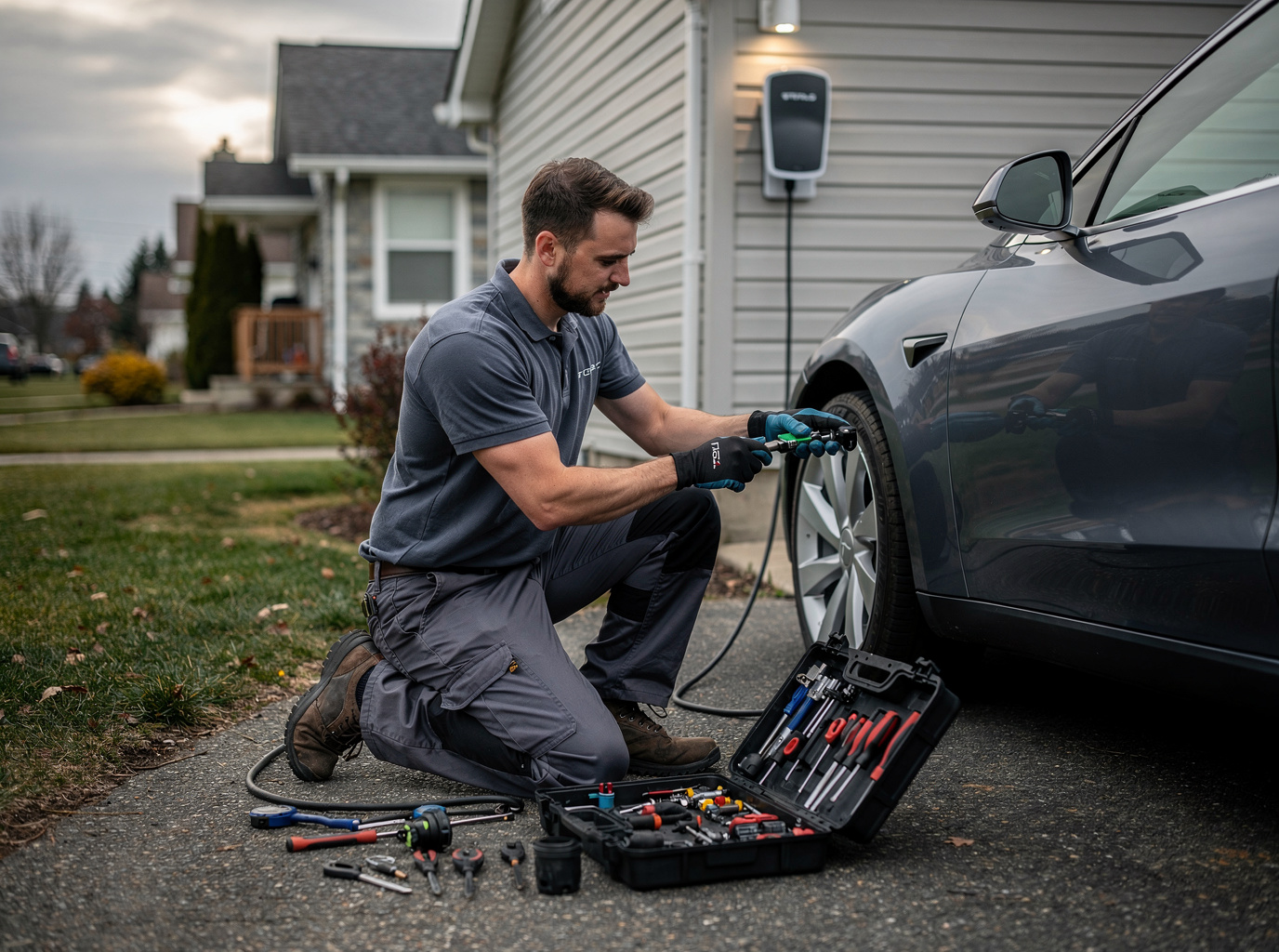
Hudson sits in Pasco County with a humid subtropical climate that brings hot, humid summers and mild winters. This moisture accelerates corrosion on outdoor EV charger connectors and enclosures, especially for properties near Hudson Beach Park or Key Vista Nature Park where salt air adds to the problem. Older homes in Sea Pines and Hudson Beach often have 100-amp or 150-amp panels that cannot support a 240-volt Level 2 charger without an upgrade. Florida electrical code requires GFCI protection on these circuits and proper spacing from windows and doors, so any install must account for both the panel capacity and the local weather exposure.
Technicians working in New Port Richey or Spring Hill see frequent callouts for chargers that stop communicating after heavy summer storms. Water intrusion at the junction box or damaged control boards from humidity are common. Homeowners sometimes attempt DIY outlet swaps using standard 14-50 receptacles that are not rated for continuous EV loads, creating heat and fire risk. Proper work includes torque checks on lugs, use of outdoor-rated conduit, and verification that the charger is listed for the exact circuit amperage available after any panel changes.
Terrain around Hudson can include sandy or low-lying lots that affect trenching depth and conduit protection. When running new circuits from the panel to a garage or driveway pad, crews must maintain required burial depths and use schedule 40 PVC or rigid conduit where the line crosses driveways. Seasonal humidity also means sealing all outdoor penetrations with the correct compounds so moisture does not migrate back into the panel over time.
Technician insight
In Hudson the thing that catches most people out with EV Charger Repair and Installation is the combination of older 100-amp panels in Sea Pines homes and the constant humidity that corrodes outdoor connections faster than inland spots like Spring Hill.
Corroded Connector in Hudson Beach
A homeowner near Hudson Beach Park reported their charger shutting down during summer rains. We found water intrusion at the outdoor junction box that had corroded the control board. After replacing the enclosure with a sealed unit and re-running the conduit with proper drip loops, the charger operated without further faults.
EV Charger Repair and Installation Services We Offer
✓Level 2 Charger Installation
Hardwired or plug-in 240-volt charger installation sized to your panel capacity and local Pasco County requirements.
✓EV Charger Diagnostics and Repair
Troubleshooting of fault codes, communication failures, and damaged connectors common after Hudson's humid summers.
✓Panel Upgrade for EV Charging
Service panel replacement or subpanel addition when existing 100-amp or 150-amp service cannot support charger load.
✓Outdoor Charger Enclosure and Wiring Protection
Weatherproof conduit, junction boxes, and sealing work to protect against Hudson's salt air and heavy rain near the coast.
✓Smart Charger Setup and App Integration
Configuration of Wi-Fi or cellular chargers with scheduling and utility rate integration for homes in Sea Pines and Hudson Beach.
✓Charger Circuit and Receptacle Replacement
Replacement of overloaded 14-50 outlets and undersized wiring with properly rated continuous-duty components.
EV Charger Repair and Installation Cost in Hudson, FL
| Service | Typical Range | What Affects It |
|---|---|---|
| Level 2 Charger Circuit Only | $650–$1,100 | Varies with distance from panel and trenching needs |
| Full Level 2 Installation with Charger | $1,200–$2,400 | Includes unit, wiring, and basic mounting |
| Panel Upgrade for EV Charger | $1,800–$3,200 | Depends on amperage increase and meter base work |
| Charger Diagnostic Visit | $125–$225 | Applied toward repair if work is approved |
Ranges are typical for Hudson, FL and confirmed with an exact written quote before any work starts.
How it works
- 1
Site Assessment
Review panel rating, existing wiring, and outdoor exposure at the Hudson property to determine charger compatibility.
- 2
Load Calculation and Permit
Calculate available capacity and pull required Pasco County electrical permit before any work begins.
- 3
Circuit Installation
Run new conduit and wiring from the panel to the charger location using weather-rated materials suited to local humidity.
- 4
Charger Mounting and Testing
Mount the unit, make final connections, verify GFCI protection, and test under load before leaving the site.
Pricing
Pricing depends on whether a panel upgrade is needed and the charger model chosen.